The MX1: The Salvage Idea That Became a House Signature
There is usually exactly one style that explains a luxury house, and at this Los Angeles label the MX1 does that job. The jean itself is a skinny five-pocket cut, distressed by hand and then patched with pleated leather let into the thinned zones. At an observed market price of $1,090 it crowns the core denim range, and everything else in the category is measured against it. Cheaper jeans exist in the line, so do newer ones and more aggressive ones, yet amiri jeans still points to this one. What follows is how a repair technique became a house signature, what the jean is made of, and which repeated claims do not survive checking. Every price here is an observed market listing, not an official price list.
A Maxfield capsule and a disputed founding date
Mike Amiri set up the label in his hometown of Los Angeles, and the brand’s own about page dates the year at 2014. The same year shows up at the CFDA, at the Italian group that later took a minority stake, and in the standard encyclopedia entry. Pulling against all of it, a press release dated 3 December 2014 places the founding in 2013 and describes it as a partnership with the luxury retailer Maxfield. Both are citable, so the honest formulation is that the brand dates itself to 2014 while the earliest contemporaneous release says 2013. There is no argument about the launch vehicle, an exclusive capsule collection at that Los Angeles concept store. Because the capsule jeans already carried out what the MX1 does now, the model works as a founding idea rather than a later www.amirishop.org addition.
What he was doing beforehand
Brand copy and the CFDA share identical careful phrasing about the founder’s start, that he began by hand-crafting unique stage pieces for legendary Los Angeles performers. Neither source says more, so the specific rock clients named in retailer editorial count as secondary reporting rather than brand statement. The defensible way to put it is that he is widely reported to have made stage pieces for particular performers, and not that the brand claims it. According to the same 2014 release, he had over ten years in the luxury market and had developed projects for Helmut Lang, J Brand and RRL. None of that is confirmed by those companies, so it is brand public relations and should be attributed as such. Also in that release, and missing from most coverage, is his appointment as head designer of ready-to-wear and accessories at Buscemi.
What the jean is, in detail
Per the official copy it is a skinny-fit jean cut from Italian stretch denim, built with classic five pockets, abraded by hand and repaired with pleated leather. Ovine leather is the stated contrast material, so neither an unspecified leather nor a synthetic. Fibre content is 92 percent cotton, 6 percent elastomultiester and 2 percent elastane, and the model is a Core Collection piece. It is made in the USA, and that matters twice over, as a fact about the brand and as an authentication check. Style codes follow a structured format, and a code should stay consistent with the style and the colourway. The pleated panels are set into the abraded zones at knee and thigh, so the leather sits where denim is missing rather than on top of intact fabric.
What the pleating is really for
Price rests on construction here, and the detail rewards precision. Anyone can fake distressing cheaply, but replacing missing denim with a shaped leather insert is a second operation laid over the first. Pleating that leather adds a third, because a pleated panel has to be formed before it can be set into an irregular opening. Hand finishing means the openings vary, which rules out cutting every panel from the same pattern. That irregularity doubles as the most reliable at-a-glance authentication tell, since counterfeit distressing is usually repetitive and flat. It is the hardest part of the product to fake at volume, and it is the actual product.
A single construction, and everything that rides on it
The variants work because the repair position, once created, will accept anything. The MX1 International exchanges pleated bandana print for the leather, in exactly same structural position. A woven paisley does the job on the MX1 Bandana Jacquard, while the Stud and Aloha versions put hardware and print onto the same base. Colourways run from black through several indigo washes to white. This is exactly why Bandana and Crystal should never be listed as fits, because they are treatments and can land on the MX1, the Thrasher or the Shotgun alike. The table separates the base jean from the treatments that ride on it.
| Name | What changes | Notes |
|---|---|---|
| MX1 | Repairs in pleated ovine leather | Base model, observed $1,090, USA origin |
| MX1 International | Pleated bandana print replaces the leather | Identical structural position |
| MX1 Bandana Jacquard | Plain leather gives way to woven paisley | Treatment on the same fit |
| Stud MX1 | Metal studding added to the base | Upper price band |
| Aloha MX1 | A printed motif over the base | Treatment, season-led |
| Baggy MX3 | A separate hybrid, motocross-inspired | Womenswear, observed $990, not a tier above |
What it costs, and what comes after
The observed full price is $1,090, against $750 for the Stack jean at the other end of the core range. Resale behaves differently, with listings on the main denim resale platform clustering roughly between $480 and $650 and a wider spread from about $400 to $840. Suede and unusual-material versions land at the lower end, because specialised materials depreciate harder. The structural reason is that the brand discounts visibly through authorised retail, by roughly 40 to 70 percent in-season, and reaches off-price channels after that. That sale floor ceilings what a secondary buyer will pay, and heavy counterfeit density adds an authentication discount on top. None of this is investment advice, and the obvious reading is that the MX1 is a garment to wear rather than to hold.
Living with a pair
Because complete measurements are not released for every style, sizing information is buyer-reported rather than published. The cut is by design narrow, and although the waist runs broadly true to the labelled inch, the leg is what sends people up a size. Buyers with heavier thighs or calves commonly report going up one or two to get a slim rather than skinny line. Core pairs are spot-clean only, and nothing else is allowed, so no washing, bleaching, tumble drying, ironing or dry cleaning, which makes care stricter than ordinary denim. The care copy also flags intentional shading variation and possible dye transfer, both features of the finish rather than defects. The checks below are the ones worth running before money changes hands.
- Confirm the origin label reads USA, since a jean marked as made in Italy contradicts the core denim
- The style code should be structured and consistent with both the style and the colour
- Make sure the contrast material is stated as ovine leather and not left unspecified
- Look for irregular, asymmetric hand distressing rather than repeating machine abrasion
What gets circulated about the MX1 and is not true
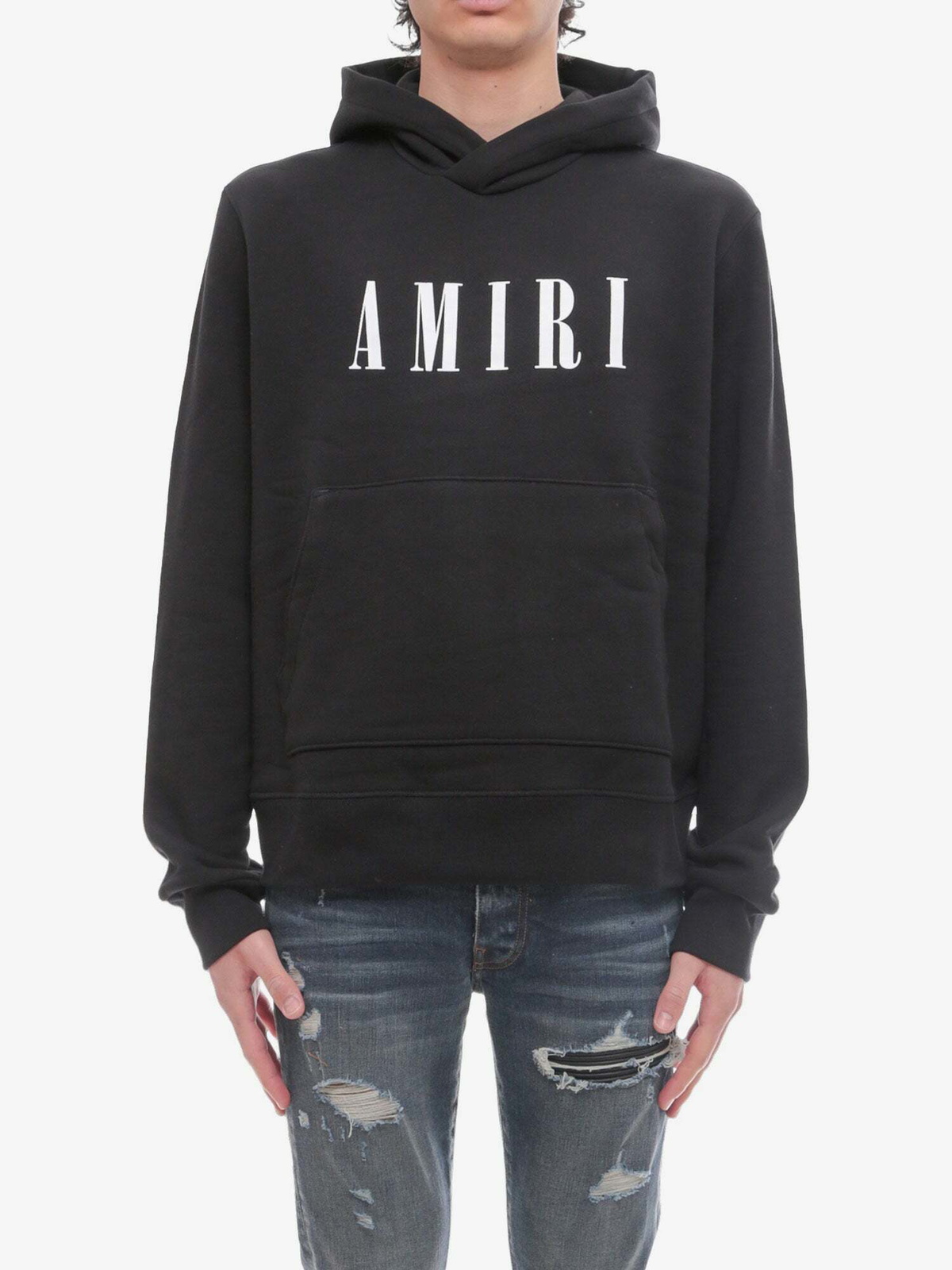
Top of the list is a numbered ladder, going MX1 for leather, MX2 for bandana and a third model for heavier destruction. That formulation is unverified and looks like search-optimised copy replicating between sites, because the only MX3 on the brand’s own site is a women’s Baggy MX3 at an observed $990. That piece is a no-waistband hybrid borrowing from motocross, and not a men’s tier above the MX1. MX2 is a real name, yet its collection pages returned no live products when checked in 2026, and sources do not agree over whether its defining feature is contrast inserts or zippered knee vents. The MX3 description makes MX as motocross a reasonable reading, though it is guesswork and not a brand statement about the MX1 name. It is also false that all amiri clothing is made in Los Angeles, because the MX1, the Stack and the core amiri hoodie are US-made and amiri sneakers are made in Vietnam.
Where the MX1 sits now
No style in the current range has taken its place. It stays in the Core Collection, stays at the top of the standard denim band, and stays the model resale platforms build dedicated browse pages around. Roomier cuts have drawn volume away from the skinny shapes, and buyers looking at amiri men now have Carpenter, Baggy and MA Fit options that did not define the early years. The MX1 now reads as a reference rather than a default, and that is the usual path for a signature product. Buy through the brand’s own channel or a retailer named on its published stockist list, which stays the safest option given that no official outlet exists. Anything advertising itself as one is not the brand, by the brand’s own legal position.